The first time I recommended Sage Intacct, the CFO asked why we were not looking at NetSuite. Fair question. Her company had 30 employees, six legal entities, a deferred revenue schedule, and a board that wanted the close done by day five. NetSuite could do the work. So could Intacct. One of them cost roughly half as much for the same scope.
She chose Intacct and spent the savings on a controller who understood revenue recognition. Three years later, the system was still doing the job. Nobody had given a keynote about it.
That is the Sage story in the US mid-market. It does not win the conference circuit. It wins a certain kind of finance-led company that cares more about the close than the logo.
The lineup is four products, not one
Sage is a British company with a long history of acquiring accounting and ERP products. That history shows up in the product names, which do not follow a clean progression and confuse almost every first-time buyer.
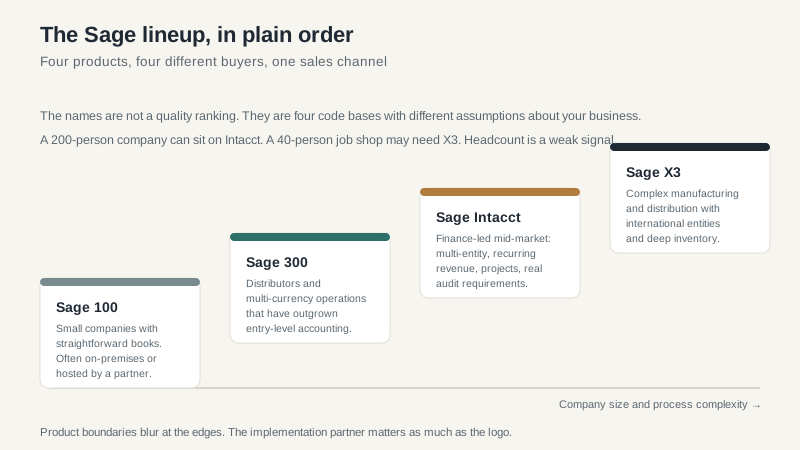
Sage 100. The descendant of MAS 90 and MAS 200. Small companies, straightforward books, often on-premises or hosted by a local partner. Mature, well understood, and not where Sage is putting its product investment.
Sage 300. The descendant of Accpac. Popular with distributors, contractors, and multi-currency operations that have outgrown entry-level accounting but do not want a full mid-market implementation. Still widely used in the US.
Sage Intacct. The cloud-native financial management platform Sage acquired in 2017. This is the product most mid-market buyers should look at if they are comparing Sage to NetSuite or Microsoft. Financials, multi-entity consolidation, project accounting, revenue recognition, and subscription billing in one system.
Sage X3. The larger ERP for complex manufacturing and distribution, with multi-company, multi-currency, and deeper operational functionality. Available on-premises or in the cloud. Different implementation community, different price point, different sales motion.
The names are not a ladder where every company climbs one rung as it grows. A 200-person SaaS company can sit happily on Intacct. A 60-person job shop with complex routings may need X3. Headcount is a weak signal. Process is the better one.
Where Sage earns its keep
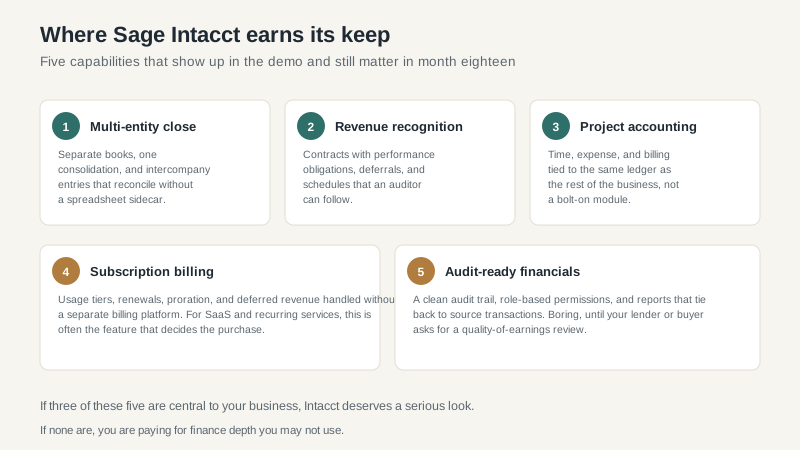
Multi-entity consolidation. Separate books, one consolidation, intercompany entries that reconcile without a spreadsheet sidecar. For a company with a US parent, a Canadian subsidiary, and a European entity, this is not a nice-to-have. It is the reason to buy the system.
Revenue recognition. Contracts with multiple performance obligations, deferrals, and schedules that an auditor can follow. Software companies, services firms, and subscription businesses all end up here. Intacct handles it natively, which is a meaningful advantage over systems that need a bolt-on.
Project accounting. Time, expense, and billing tied to the same ledger as the rest of the business. Professional services firms that run projects and a P&L in separate systems feel this pain every month. Intacct puts them in one place.
Subscription billing. Usage tiers, renewals, proration, deferred revenue. For SaaS and recurring services, this is often the feature that decides the purchase. The alternative is a billing platform plus an integration plus a reconciliation exercise.
Audit-ready financials. A clean audit trail, role-based permissions, and reports that tie back to source transactions. Boring, until a lender or a buyer asks for a quality-of-earnings review and you need to explain every adjustment.
Add a partner ecosystem that is smaller and, in my experience, more responsive than the big enterprise channels. When something breaks, you are more likely to reach someone who knows your instance. That is worth real money in year two.
Where Sage loses
Manufacturing depth. Intacct is a financial management platform. If you need deep production scheduling, routings, work orders, and shop floor control, you are looking at X3 or a different vendor. Do not let a partner talk you into an add-on that turns Intacct into a manufacturing system unless you have seen it run a process like yours.
Brand and ecosystem. NetSuite and Microsoft have larger partner networks, more integrations, and more recruiters who know the product. Sage’s ecosystem is smaller. That can mean better attention and fewer options, depending on what you need.
Enterprise scale. If you have thousands of users, dozens of entities, and a global shared services center, Sage is not the first call. Intacct can scale further than people think, but it is not built for the same ceiling as Fusion or Dynamics 365 Finance.
The older products. Sage 100 and Sage 300 are stable and well supported, but they are not where the company is investing for the next decade. If you are buying one now, ask the partner what the five-year roadmap looks like and whether the cloud version is a real product or a hosting arrangement with a new name.
Pricing and implementation
Sage does not publish complete list pricing, and quotes vary by partner. Intacct entry packages can start in the low hundreds per month for a small team, but a real mid-market deployment with multiple entities, users, and modules lands in the tens of thousands per year. Implementation is typically two to five months for a finance-led scope, longer if you are consolidating entities or migrating a lot of history.
X3 is a different budget. Expect a larger implementation, a longer timeline, and a partner with manufacturing experience. The software is capable. The project is not a quick one.
Ask three questions before you sign:
- Which modules are included, and which are priced separately? Multi-entity, revenue recognition, and project accounting are often separate line items.
- How many named users are included, and what happens when we add a read-only user or a contractor?
- Who implements it, and how many live Intacct customers of our size can they reference?
Who should choose Sage
If your company is finance-led, multi-entity, and growing through acquisitions or new product lines, Intacct is a strong fit. If you sell projects, subscriptions, or services and your current system requires a spreadsheet to recognize revenue, it is worth a serious look. If you are a nonprofit with restricted funds and grant reporting, the partner ecosystem around Sage is deep.
If you are a complex manufacturer, a global enterprise, or a company that needs a large partner bench in every country, look elsewhere. Sage can still win, but the burden of proof is higher.
The quiet option is not the wrong option. It is simply less marketed. Ask for references, check the partner’s depth, and run your worst month-end close in the demo. If the system handles it without a consultant narrating what would normally happen, you have found something worth keeping.
If you are still building a shortlist, compare this against the NetSuite ERP system and Microsoft ERP options. Those are the two names most Sage buyers end up evaluating, and the trade-offs are real.
