NetSuite’s best salesperson is a finance team that has just closed the books across four entities using a spreadsheet, a prayer, and a folder called “eliminations final v7.”
I have seen that team buy NetSuite in a month. The pitch is simple: one database, one chart of accounts, every subsidiary and currency in the same system, and a consolidation that does not require a side file. For a company that has grown through acquisitions or expanded into new countries, that promise is worth a lot.
The bill is worth understanding too. NetSuite is not the most expensive ERP in the market, but it is not a commodity subscription. The one-database promise is real, and so are the add-on modules, the partner work, and the annual increases that show up after the honeymoon.
What NetSuite actually is
NetSuite launched in 1998 and was acquired by Oracle in 2016. It is a cloud ERP built for mid-market companies, with a broad set of modules: financials, CRM, order management, inventory, purchasing, projects, revenue recognition, and manufacturing. The core differentiator is OneWorld, which lets a company run multiple subsidiaries, currencies, and tax regimes in one instance.
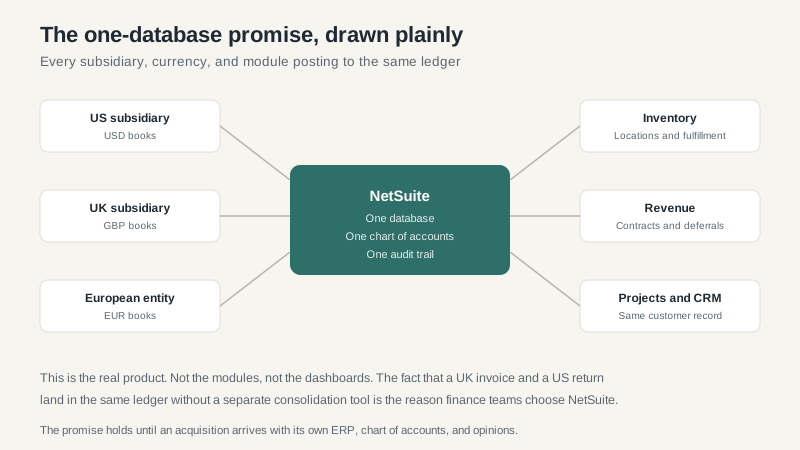
That architecture is the reason finance teams choose NetSuite. A UK invoice and a US return land in the same ledger. Intercompany transactions can be automated. The chart of accounts can be standardized without forcing every subsidiary into the same legal entity structure. For a company with operations in three countries, this removes a whole category of month-end work.
It is also the reason NetSuite struggles with certain acquisitions. If the acquired company runs its own ERP and has no intention of changing, you are back to an integration project. One database only helps when everyone agrees to use it.
The modules are the business model
NetSuite’s pricing is built around a base subscription plus modules plus users. The base gets you financials and a set of core capabilities. Order management, inventory, manufacturing, projects, revenue recognition, and CRM can be included or added depending on the package. The more modules you need, the more the annual subscription climbs.
That is not a criticism. It is how enterprise software is sold. The practical implication is that two companies of the same size can pay very different amounts for “NetSuite” because they bought different modules and different user types.
Ask for the module list in writing. Then ask which modules are included in the first-year price and which are on a future roadmap. I have seen companies sign a deal that looked competitive, then discover that warehouse management, revenue recognition, or advanced manufacturing was a separate line item. The total was not wrong. It was just incomplete.
SuiteSuccess is NetSuite’s packaged implementation methodology. It includes pre-built configurations for common industries and a faster deployment path. For a company with standard processes, it can shorten the timeline and reduce cost. For a company with unusual processes, it can feel like a box that does not fit. Ask the partner how much of your scope is actually SuiteSuccess and how much is custom.
Customization: powerful, and easy to overdo
NetSuite is highly customizable. SuiteScript lets developers extend the platform. SuiteFlow handles workflows. SuiteBuilder lets administrators add fields, forms, and records. For a company with a genuinely unique process, that flexibility is valuable.
It is also a maintenance obligation. Every custom script has to survive two major releases a year. Most do. Some do not. The ones that break tend to break during a close or a peak shipping week, which is the worst possible time.
My advice: customize the workflow before you customize the code. Use SuiteFlow for approvals and notifications. Use SuiteScript when there is no other way. Document everything. Keep a list of customizations with an owner and a test plan. When the consultant who wrote the script leaves, the list is the only thing standing between you and an unpleasant surprise.
What implementation looks like
A single-entity, finance-led NetSuite implementation can go live in three to six months. A multi-entity deployment with inventory, order management, and integrations usually takes six to twelve. Manufacturing and complex revenue recognition push it longer.
The work is predictable: process design, configuration, data migration, integration, testing, training, and a period of hypercare. The variance comes from data quality and decision speed. NetSuite is configurable enough that every unresolved process question becomes a configuration debate. Companies that make decisions quickly move quickly. Companies that wait for consensus discover that the go-live date is a suggestion.
The partner matters more than the license. NetSuite has a large partner ecosystem, and the quality ranges from excellent to “we will figure it out together.” Ask for references in your industry and your size band. Ask how many SuiteSuccess implementations the partner has done. Ask what happens when you need help at month-end and your account manager is on vacation.
The bill after go-live
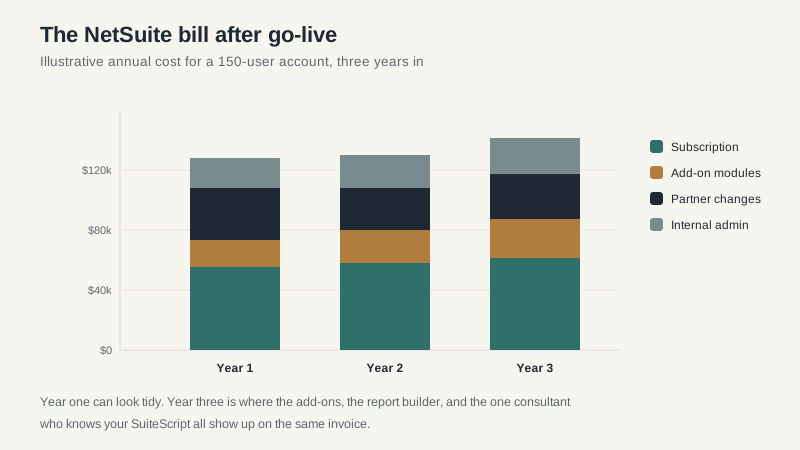
Year one includes the subscription and the implementation. Year two is mostly subscription plus the changes you did not anticipate. Year three is subscription, add-ons, partner work, and the internal administrator who now owns the system.
The renewal is the line to negotiate before you sign. NetSuite typically increases list prices annually, and multi-year deals often include an uplift clause. Ask for a cap. Ask what happens to your price if you add users or modules. Ask whether the renewal price is based on list or on your original discount. These questions are easier to ask during the sales cycle than after.
Also budget for a report builder or a finance systems analyst. NetSuite’s saved searches and SuiteAnalytics are powerful, and they are not intuitive for every user. The companies that get the most out of the system usually have one person who becomes the internal expert. That person is worth more than the next module.
Who should choose NetSuite
Multi-entity companies. If you have subsidiaries, multiple currencies, and a consolidation process that lives in spreadsheets, NetSuite is one of the strongest mid-market options. The one-database architecture is a real advantage.
Subscription and services businesses. Revenue recognition, project accounting, and recurring billing are well supported. If you sell contracts with performance obligations, this matters.
Wholesale and distribution. Inventory, order management, purchasing, and fulfillment are solid. Companies with a few hundred SKUs and a handful of warehouses can run well on NetSuite.
SaaS and ecommerce. The CRM and order management integration is useful, and the platform handles multi-channel sales without a separate system for every channel.
NetSuite is less compelling for a single-entity company with simple books. You may be paying for consolidation and module depth you will never use. It is also not the first choice for complex manufacturing; the manufacturing module exists, but Epicor and Sage X3 go deeper. And if your transaction volume is enormous, the per-transaction and per-user costs need a hard look.
How to buy it without overpaying
- Define the modules before the demo. The demo is designed to show everything. Your contract should show what you are actually buying.
- Separate license from implementation. Compare them independently. A cheap license with an expensive partner is not a bargain.
- Get two references on the exact module set. Not a general NetSuite reference. A company that uses the same modules you are buying.
- Negotiate the renewal cap. The first-year price is not the price. The renewal is.
- Plan for one internal expert. Budget the role, or plan to pay a partner for every change. Neither is free.
NetSuite is a strong system for the right company. The one-database promise is not marketing. It is the reason the product exists, and it is worth paying for when your business actually has the complexity it solves. If you do not, the bill will feel larger than the value. If you do, you will wonder how you closed the books before it.
If you are still comparing platforms, the Oracle ERP guide explains how NetSuite fits alongside Fusion and E-Business Suite. The cloud ERP guide covers the cost curve in more detail.
