The first Epicor demo I sat through was not impressive. The screens looked like they had been designed by people who spent more time in a factory than in a design studio. The colors were functional. The menus were deep. Nobody used the word “delightful.”
Then the consultant ran a what-if on a hot order. A customer wanted 400 units moved up two weeks, and the scheduler recalculated the shop load, flagged the two work centers that would break, and showed the overtime cost before anyone opened a spreadsheet. The room got quiet. The operations manager leaned forward and said, “Can you do that again?”
That is the Epicor proposition. It is not the prettiest system in the category. It is one of the few that understands what happens when a machine goes down on second shift.
A portfolio of industry products
Epicor is not one ERP. It is a group of products, each built for a specific industry, sold through partners who specialize in that industry. The name on the contract matters as much as the vendor logo.
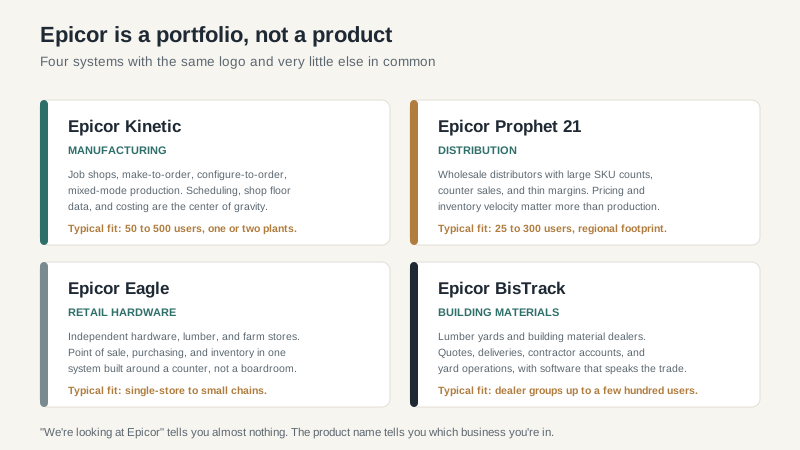
Epicor Kinetic. The manufacturing ERP, formerly known as Epicor ERP 10. Job shops, make-to-order, configure-to-order, mixed-mode production. Scheduling, shop floor data collection, costing, quality, and maintenance are the center of gravity. This is the product most people mean when they say Epicor ERP.
Epicor Prophet 21. The distribution system. Wholesale distributors with large SKU counts, counter sales, and thin margins. Pricing, inventory velocity, purchasing, and customer service matter more than production. Prophet 21 has a loyal base because it understands the distribution counter, not just the warehouse.
Epicor Eagle. Retail hardware, lumber, and farm stores. Point of sale, purchasing, and inventory in one system built around a counter. Not a general-purpose ERP. A vertical system that does a specific job.
Epicor BisTrack. Building materials dealers. Quotes, deliveries, contractor accounts, and yard operations. If you sell lumber and windows to contractors, the software speaks your language. If you sell something else, it does not.
There is also iScala and a handful of older products in the portfolio. The pattern is consistent: Epicor buys or builds software for a trade, then sells it through partners who know that trade. That is a different model from Microsoft or Oracle, which sell horizontal platforms and rely on partners to add industry depth.
Where Kinetic earns its keep
Scheduling. The finite capacity scheduler is the feature that changes the conversation. It can model constraints, prioritize orders, and show the operational cost of a promise. For a job shop with 30 machines and 200 open orders, that is the difference between a sales team that promises confidently and one that promises hopefully.
Shop floor data. Bar-code clocking, production reporting, and real-time status. The system knows what is running, what is late, and what is waiting on material. That sounds basic. In a lot of general-purpose ERPs, it is an integration project.
Costing. Standard, actual, and average costing with the ability to see variance by job, operation, and material. For manufacturers with tight margins, this is not a reporting nicety. It is how you decide which jobs to take.
Industry depth. Quality modules, maintenance, configure-to-order rules, and the data model that goes with them. Epicor has been in manufacturing for decades. The product knows the difference between a routing and a bill of materials, and it treats both seriously.
Where Epicor frustrates
Financials and reporting. The manufacturing side is strong. The financial side is adequate. Controllers who come from NetSuite or Sage Intacct often find the reporting less flexible and the close process more manual. It works. It is not the reason people buy Epicor.
The user interface. Epicor has invested in modernizing Kinetic, and the newer screens are better than the old ones. The experience is still inconsistent in places, especially in older modules. Users learn it. They rarely love it.
Customizations and upgrades. Epicor implementations often include customizations, and every customization is a future upgrade risk. The product has tools to manage this, but the discipline has to come from the partner and the customer. Companies that customize heavily and skip upgrades for years end up with a project, not an upgrade.
Partner dependency. Epicor sells through partners, and the quality varies. A good partner who knows your industry is worth a lot. A partner who is learning manufacturing on your project is an expensive education.
What implementation actually looks like
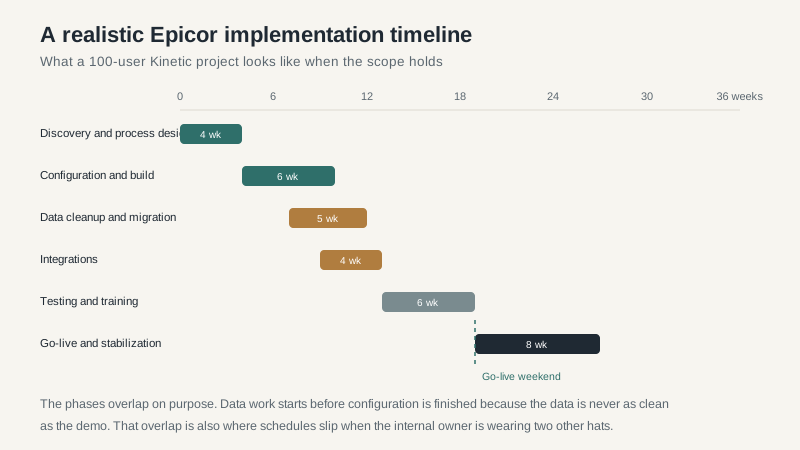
A 100-user Kinetic project with a moderate scope runs about seven to nine months. Discovery and process design take four to six weeks. Configuration takes another six to ten. Data cleanup and migration overlap with configuration, and integrations overlap with testing. Go-live is a weekend, followed by four to eight weeks of stabilization where the real issues show up.
The timeline holds when three things are true: the scope is frozen before build, the internal team has real decision authority, and the data is cleaner than average. Most projects have at least one exception. The ones that go badly have all three.
Budget is harder to pin down than timeline. A 50-user job shop might spend $100,000 to $200,000 in the first year, including software and services. A 200-user manufacturer with multiple plants and complex integrations can spend several times that. The software is not the expensive part. The process work is.
How to evaluate Epicor without drinking the demo
Visit a reference site. Not a video call. A plant tour, if you can. Watch how the scheduler is actually used, not how it is demoed. Ask the production manager what they still do in Excel.
Run your worst job. A configure-to-order job with a customer-specific drawing, a material substitution, and a ship date that already moved twice. Make the partner run it live. If they need to “set it up first,” that is your answer.
Ask about the upgrade path. Which version are you buying? How many versions behind is the reference customer? What did the last upgrade cost in time and money? If the partner cannot answer, they have not done one recently.
Check the partner’s manufacturing references. Two companies, same product, same industry, two years live. Ask what broke and how the partner responded. The response matters more than the break.
Who should choose Epicor
If you are a manufacturer with real scheduling complexity, a job shop, a make-to-order operation, or a mixed-mode plant, Epicor Kinetic deserves a place on the shortlist. It was built for your problems, and the depth shows.
If you are a distributor with a counter and a large SKU count, Prophet 21 is worth a look. If you are a retailer in hardware or building materials, Eagle and BisTrack are vertical systems that may fit better than a general ERP.
If you are a services company, a software business, or a manufacturer with simple assembly and a strong finance-first orientation, Epicor may be more machine than you need. Look at Sage or NetSuite first. The ERP software guide lays out the selection process if you are still at the beginning.
Epicor is not trying to be everything to everyone. That is exactly why it works for the companies it fits.
