The most expensive Oracle mistake I see is not choosing the wrong module. It is choosing the wrong Oracle.
Two years ago I sat in a conference room where three partners presented “Oracle ERP” quotes. The numbers ranged from $180,000 to $760,000 for what the buyer assumed was the same product. It was not. One quote was Oracle Fusion Cloud ERP. One was NetSuite, which Oracle owns and sells through a different channel. The third was an E-Business Suite upgrade dressed up as a cloud migration. The buyer had spent six weeks comparing prices for three different products and did not know it until the second meeting.
Oracle sells more than one ERP. The first decision is not which version. It is which Oracle.
Three products, one logo
For a mid-market or enterprise buyer in the United States, “Oracle ERP” usually means one of three things:
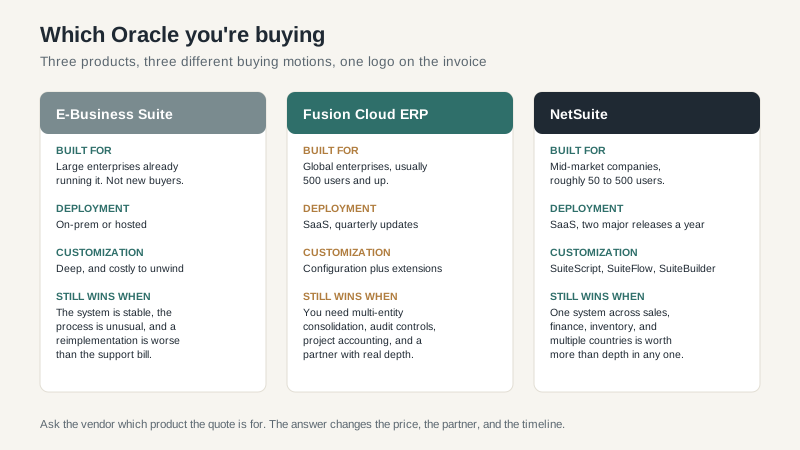
Oracle E-Business Suite. The on-premises workhorse that many large companies still run for financials, manufacturing, and supply chain. EBS is not dead. Oracle has committed support for the 12.2 line well into the 2030s, and plenty of companies have no business case to move this year. But the population of consultants who know EBS deeply is shrinking, and every customization you add makes the eventual move more expensive. If you are on EBS and it works, the honest question is not “when do we move?” It is “what would have to be true for a move to pay for itself?”
Oracle Fusion Cloud ERP. The flagship SaaS product, built from the ground up for the cloud. Financials, procurement, project management, and risk management in one subscription. Supply chain is a separate cloud suite that Oracle will happily sell alongside it. Fusion is designed for larger, multi-entity organizations with serious audit and consolidation requirements. It is also priced and implemented accordingly.
NetSuite. Oracle’s mid-market ERP, acquired in 2016. One database, one chart of accounts, a broad set of modules, and a sales motion that moves much faster than Fusion. Most companies between 50 and 500 users end up looking at NetSuite before Fusion, whether or not they realize both are Oracle. The NetSuite guide covers that product separately because the buying experience is genuinely different.
E-Business Suite: stay or move?
I have worked with EBS customers who have run the same heavily customized instance for fifteen years. The system closes the books, ships product, and does things no cloud product does out of the box. Rip and replace would cost millions and take years. For those companies, staying is usually rational.
The trap is staying without a plan. EBS support is not the same as EBS investment. New features slow down, integrations get harder, and the consultants who understand your customizations retire or move to cloud projects. If your EBS instance is held together by two people and a documented list of workarounds, you have a succession problem, not just a software problem.
My rule: if the customization list is longer than the standard process list, fix the process before you start a cloud business case. Otherwise you will spend the first year of the migration recreating the same mess in a more expensive environment.
Fusion Cloud ERP: what you are actually buying
Fusion is a strong product for the right company. Multi-entity consolidation, intercompany accounting, project accounting, procurement controls, and a reporting layer that finance can defend to auditors. The quarterly update cycle is real and mostly welcome, but it means you cannot treat the system as a frozen custom build. The extension model exists for a reason. Companies that try to recreate twenty years of EBS customizations as Fusion extensions tend to have a bad time.
The implementation is where the money goes. A mid-size Fusion program typically runs nine to eighteen months and costs more than the first three years of subscription. That is not Oracle-specific. It is what happens when you replace the financial backbone of a company with operations in multiple countries.
Partner quality matters more than the product demo. Oracle has a large partner ecosystem with wildly different levels of skill. The same license can be implemented by a team that has done thirty Fusion projects or by a team that has done three. Ask for the names of the actual consultants, not the partner’s logo. Ask for two live references on the exact modules you are buying. If the partner cannot produce them, keep looking.
Pricing is a conversation, not a list
Oracle does not publish list prices for Fusion in any useful way. Quotes are built around user counts, modules, cloud credits, and whatever commercial structure the deal team thinks will close. Two companies of similar size can pay very different amounts for the same product.
That is not automatically a problem. It does mean you need a benchmark before you negotiate. Talk to a partner who is not bidding, or a procurement advisor who has seen recent Oracle contracts. Ask what the subscription includes, what it does not, and how the price changes at renewal. Oracle’s renewal team is not the same as the sales team, and renewal increases are a real budget line.
Watch for bundles that claim to include implementation. The implementation is either scoped tightly enough to be credible or it is a placeholder for change orders. Ask what happens when your data is worse than expected. The answer tells you how the project will actually be priced.
Where Oracle projects overrun
The overrun pattern is remarkably consistent across Oracle products, and it is not mostly about license cost.
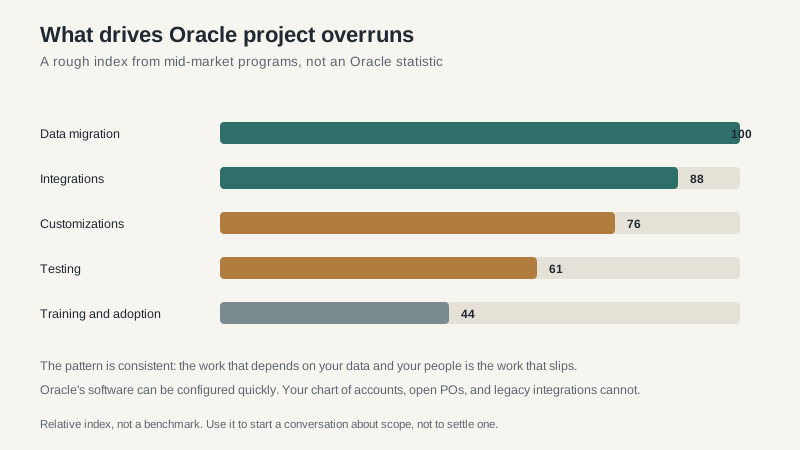
Data migration. The item master is always worse than the steering committee believes. Duplicate vendors, orphaned POs, and customers with six ship-to addresses and three tax IDs. The cleanup is not glamorous and nobody wants to fund it. It is also the single best predictor of whether go-live is calm or chaotic.
Integrations. Banks, EDI, payroll, the warehouse system, the tax engine, and the ecommerce platform. Each one has an owner, a format, and an exception process. Each one is a small project hiding inside the big one.
Customizations. Oracle products can be extended, but every extension has a maintenance cost. The finance team will ask for a report that looks exactly like the old one. The operations team will ask for a screen that behaves exactly like the old one. Some of those requests are legitimate. Some are nostalgia. A good partner helps you tell the difference.
Testing. Not the scripted demo. The integration test, the close test, the “what happens when the bank file fails at 11 p.m.” test. Teams consistently underfund this because it feels like the project is almost done. It is not.
Training and adoption. The lowest index on the chart and the one that determines whether the system is used properly after the consultants leave. Budget for it. Then budget a little more.
How to choose without getting played
Decide the product before the partner. A partner that only implements Fusion will not tell you NetSuite is a better fit, and a NetSuite partner will not tell you Fusion is. That is not dishonesty. It is incentives.
Once the product is decided, require the exact product name on every quote and contract. “Oracle ERP” is not a product. “Oracle Fusion Cloud ERP, Financials and Procurement, 250 users” is a product. If a partner cannot put that in writing, the comparison is meaningless.
Then interview the implementation team. Not the sales team. The people who will sit in your conference room and tell you your chart of accounts needs to change. Ask them what went wrong on their last two projects. A team that cannot answer that question has not been paying attention.
Who should pick which
If you are a large enterprise with multi-entity operations, serious audit requirements, and a real budget for a multi-year transformation, Fusion Cloud ERP is a credible choice. If you are a mid-market company that wants one system across finance, sales, and inventory without a nine-month enterprise program, look at NetSuite first. If you are already on EBS and it is stable, do not let a vendor talk you into a cloud migration before you have a business case that survives a CFO review.
And if you are still early in the process, read the ERP software buying guide before you take another demo. The product shortlist is the second decision. The first one is whether you are ready to change how the company works.
